
O'HARE BEWARE
THE TURBULENT HISTORY OF O'HARE AIR RESERVE STATION, 1949-1996, SEEN THROUGH THE EYES OF THE CHICAGO TRIBUNE AND A/2C JAMES TESTIN
O’Hare International Airport had its humble beginnings in the early twentieth-century as Orchard Place Airport. The small, regional airfield was then overshadowed by the Chicago Municipal Airport, later expanded and renamed Midway International Airport. The vestiges of history can still be found in O’Hare’s IAIA Code–ORD, an abbreviation of Orchard. During World War II, the site was operated by the Douglas Aircraft Company to produce C-54 Skymaster personnel transport planes for the war effort.
The name O’Hare—championed by the Naval Airmen of America and the Chicago Tribune,[1] and bestowed on the property in 1949—honors 1942 Medal of Honor recipient Lieutenant Commander Edward Henry “Butch” O’Hare of the US Navy. He was the Navy’s first fighter ace, earning the military’s highest honor for defending the USS Lexington with his Grumman F4F-3 Wildcat in what his presidential citation called “one of the most daring, if not the most daring single action in the history of combat aviation.”[2] O’Hare was declared missing in action a year and a half later when his plane was lost near Tarawa Atoll. His body was never recovered. Though Lt. Cdr. O’Hare’s connection to Chicago was tenuous at best, his father, Edward J. O’Hare, was an undercover IRS agent in Al Capone’s Chicago mob, a role for which he was murdered in 1939.[3] On 17 September 1949 Selma O’Hare arrived along with a demonstration team of 175 Navy planes and some 200,000 spectators to witness the dedication of the Air Reserve Station in her son’s honor.[4] By 1950, the O’Hare ARS would have its first experience as a wartime air base. The 62d Jet Fighter Squadron was stationed there August 1950, and several wings of reserves joined in active duty during the conflict in Korea.[5] O’Hare would not allow its location in the Midwest to limit its support in the Cold War effort.

Jim Testin in The Loyolan yearbook, 1950. (Loyola Archives)
James “Jim” Testin[6] was in high school in Glen Ellyn, IL when World War II ended, and a freshman at Loyola University Chicago when O’Hare ARS was dedicated. Perhaps the only luck that could be attributed to the children of the Great Depression (1929-1939) was that they were too young to face the horrors of WWII, at least in the United States where drafted service began at 18. Testin’s generation was not so lucky when war broke out in Korea half a decade later. A freshly graduated accounting major facing the prospect of the draft and seeking to control his placement in the service as much as possible, Testin enlisted in the newly minted United States Air Force on 7 July 1952. Testin completed BCT at Spence AFB in Georgia, and qualified on use of the M1 Carbine at a base in Texas. Testin began flight school on a T-6 Texan, wary that it would force him to remain in the service for longer than his minimum two-year enlistment required at the time. After his officers determined he was not “fighter pilot material,” Testin was also denied flight training on larger, multi-engine planes, for which it was decided the Air Force had enough pilots at the time. His training cut short, Testin lamented nearly 70 years later, “Egads! They taught me how to take off, but they never taught me how to land!” [7] Testin got a lucky break when a friend of his arranged for them to be transferred to O’Hare Air Reserve Station, located just west of Chicago, and just north of where they grew up in Glen Ellyn. Though most of the airmen lived in barracks at O’Hare, Testin was able to commute from home. At O’Hare, Testin joined the 2471st AFRCTC as a clerk. His job was to keep track of which reserves showed up to work and which reserves shirked their duties. He worked in an office of about 25 other clerks but does not recall there being much work to do. Testin was getting his CPA at the time, already preparing for life outside the Air Force. His closest encounter with aviation at O’Hare ARS was a flight he took in an Air Force plane to Detroit to retrieve some paperwork. In the final months of his enlistment, Testin worked to ensure his specialty never aligned with that of the airmen being transferred around the US, or worse, around the world. He was honorably discharged from the service, and O’Hare ARS, 6 July 1954, [8] having achieved the rank of A/2C and having never left the States.
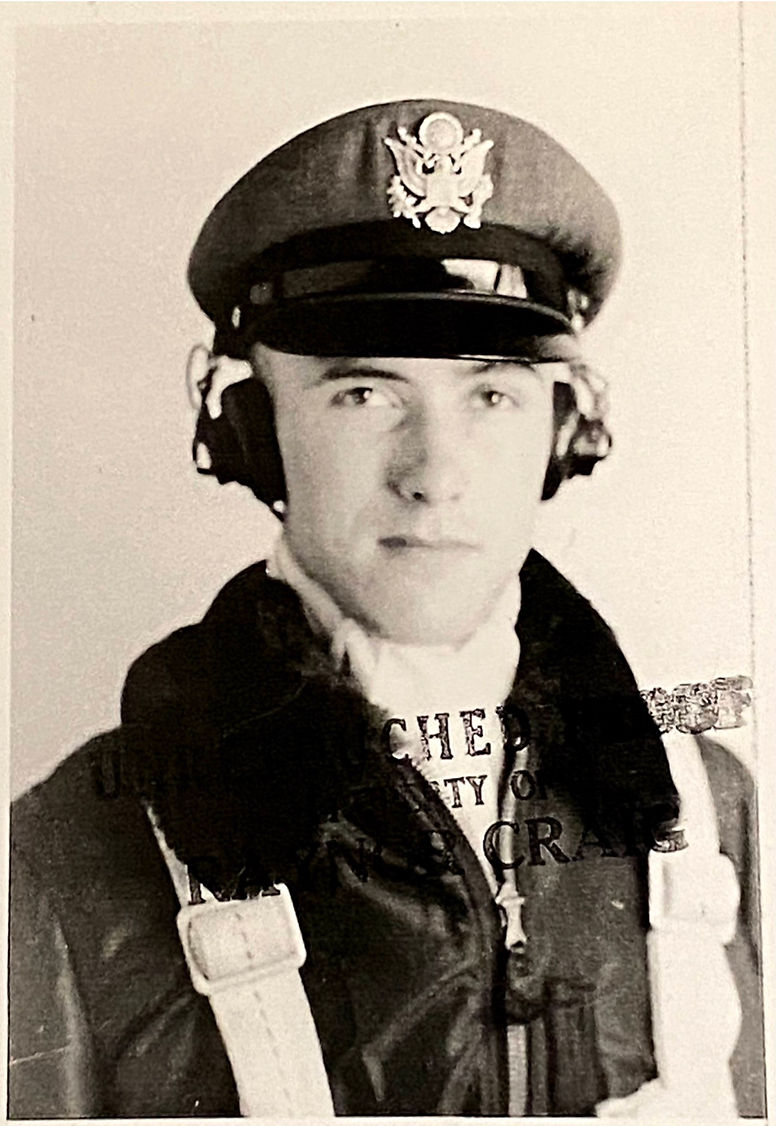
Jim Testin in the Air Force, c. 1952. (Jim Testin)
Controversy began brewing at O’Hare just as Testin left the Air Force. Throughout the 1950s, aviation gained civilian attention in addition to military attention. O’Hare’s convenient location pitted it at the very center of these tensions. The first signs of discontent were made known in a 1952 hearing amid plans to expand Air Force operations at O’Hare. Concerns revolved around excessive air traffic as O’Hare tried to develop simultaneously as an air reserve station and an international airport, especially in the predicted event of escalated conflict and military activity during the Cold War. At this hearing, the Air Force saw the first proposal for joint use of the Navy’s air base at Glenview, though this would do little to ease congestion in the event of mobilization. No resolution beyond acknowledgement of the problem was achieved by this hearing as both the military and civilian sides of O’Hare continued to grow in the coming years.[9] During the explosive period of the Cold War, fear that Chicago could be the target of an enemy attack, and therefore would need a large Air Force presence to protect it, was neither an uncommon nor an inordinately paranoid sentiment.
At the same time that air defense was hot in the minds of Chicago residents, so too was air travel. However, August 1952 Mayor Martin Kennelly conceded, “Chicago has neither the intent nor the funds to build another airport.”[10] A new cold war was brewing between the City of Chicago and the Air Force over control of the runways at O’Hare. Kennelly’s first attempt to stymie Air Force growth came days later when he demanded that the City Council cease to grant more leases and building permits in the O’Hare area, including, or rather especially, those leases and permits to the Air Force. Kennelly and others knew that the more the Air Force established its infrastructure on the site, the more difficulty they would have in forcing the ARS to move.[11] Col. Fred T. Crimmins told the Tribune, “We of the air force certainly do sympathize with Chicago’s problems,”[12] though he offered no support in changing the expansion plans being executed by his organization. Enraged, Kennelly’s view was that “O’Hare’s loss to the military would set Chicago back seven years in providing badly needed civil airport facilities.”[13] The joint use of O’Hare was to the liking of none. Lt. Gen. James H. Doolittle advised so strongly against joint use of the airport that he submitted a report to President Harry S. Truman.[14] In 1953, officials decided that the Air Force would move its operations south of the city, south even of Midway International Airport. A settlement in the loss of O’Hare by the Air Force would most likely include the City of Chicago paying for the construction of the new base, [15] a small price for the spoils of war.

O'Hare in 1951, ARS area marked (Nationwide Environmental Title Research)
The situation looked promising for the disintegration of O’Hare ARS in the 1950s. Yet financial, geographical, and logistical factors caused plans to relocate the air base to disappear into the wild blue yonder. In 1957, Air Force operations decreased at O’Hare only due to national disbandment measures after the Korean War. Air Force activity otherwise remained at odds with civilian flight patterns.[16] Still facing hostility, O’Hare ARS sought to integrate itself into the Chicago community. In 1964, O’Hare offered an Armed Forces Day celebration complete with plane tours, demonstrations, and other activities.[17] With tensions still boiling between civilian and military affairs, proposals for an expansion of the Gary Municipal Airport, just across the Indiana border southeast of Chicago, were made in 1965. The idea was for this airport to pull civilian traffic from Midway and O’Hare.[18] This plan circulated for more than half a century. Yet in 2021 the Gary/Chicago International Airport had failed to establish itself as the great alternative to O’Hare and Midway. In 1965, a deadly crash of a Navy aircraft at O’Hare exposed problems with visibility and congestion.[19] The situation was definitely still up in the air.
In 1968, Mayor Richard J. Daley moved to expand O’Hare International Airport by 370 acres through the seizure of Air Force property. As a consequence of the civilian expansion, Chicago was thereafter responsible for sinking millions of dollars into the Air Force’s move to Glenview. This simply solved one problem and created another. Alderman Jack I. Sperling offered his perspective: “I think there should be serious consideration before moving more airplanes, particularly jets, to Glenview. There has been considerable discontent among Glenview residents and a recent accident in a residential area. I wonder if we should give Glenview—the town—this new burden?”[20] The accident referenced was a July 1968 incident in which a jet fighter hit a house and killed a teenage girl.[21] Additionally, Glenview Village President Paul H. Thomas vowed to “fight” the transfer of Air Force operations to his community.[22] Glenview’s defenders even made weak attempts at suggesting alternative options in Wisconsin.[23] Once again, the issue stagnated for several decades before moves would be made to settle the issue once and for all. Following the end of the Cold War in 1991, a nationwide move to close military stations deemed the Glenview site unnecessary to national security. As a 1993 article explained, “political leaders in Chicago and the suburbs appear to be engaged in a game of hot potato over the future of the U.S. Air Force Reserve base at O’Hare International Airport.”[24] Without the immediate security concerns demanding military protection of Chicago, the ARS found itself losing altitude.

O'Hare in 1993, ARS area marked (Google Earth)
At long last, the military overlords made the decision Chicago debated for half a decade. In 1993, it was announced that the O’Hare Air Reserve Base would be closed along with the Glenview Naval Base and bases in some 30 other communities nationwide. Mayor Richard M. Daley cited the closures as “a victory for Chicago.”[25] While it may have seemed like a victory, Chicagoans were hesitant to accept the news of the closure with rejoicing. Industry focused on the presence of military personnel would be lost, and as operations at the ARS had grown quieter, fears heightened over the construction of new civilian runways that would increase air traffic and noise in the surrounding areas.[26] In 1993, the Department of Defense’s Base Closure and Realignment Commission announced that the ARS would be closed by 1998. Daley immediately commenced plans to develop the 350+ acres of land that would be turned over to the city, with commercial ventures. At the time, he promised there would be no additions to the existing six runways, and therefore no increased air traffic. Local citizens, however, were wary that this would not be the case. Chicago’s confiscation of the land, they feared, would “exacerbate noise and air pollution.”[27] The entire plan was contingent on Chicago paying for the relocation of the Air Force base, which cost approximately $350 million.[28] Daley promised taxes would not be raised, but rather loans would be paid by the new developers moving into the open O’Hare area. Seeing an opportunity to enhance local economies, many other communities began vying for the new Air Force Base, including Rockford, Peoria, Rantoul, Springfield, East St. Louis, Bloomington, and the Quad Cities. Later, Operations Desert Storm and Restore Hope had displayed the necessity of a base in the general vicinity of O’Hare, somewhere in Illinois.[29] The communities contending for the base, however, did not want to become entangled in a bidding war as many were hoping to gain it as a boon to their struggling economies.[30] The announcement of the closure instead opened a flurry of lobbying as the decision on relocation was left to the Air Force, but would surely be influenced by the Chicago government.
With its fate sealed, at least as far as the ARS closing, a few more years to remained for the Air Force. In 1994, O’Hare ARS hosted a World War II reenactment for a crowd of 175,000, even as the ARS was itself becoming history.[31] But 1994 was not just about celebration. On the flipside, it brought the laying off of some 300 civilian employees amid post-Cold War military downsizing. As the Tribune put it, cutting civilian jobs “signals the beginning of the exodus of the military from the O’Hare Air Reserve Station.”[32] The ARS was slowly but surely closing in on its final days.
In 1995 officials decided that the O’Hare and Glenview bases would not be relocated elsewhere in the state, but dissolved altogether. President Bill Clinton planned to cut 38,000 service members from the Reserve and National Guard, including Reserve Airmen who worked at O’Hare. The continental threats of the Cold War were behind the US, and until the terrorist attacks of 2001, cities in the US would be lulled into a sense of security regarding their imperviousness to airborne threats. The role of the O’Hare base was simply deemed unnecessary. Brig. Gen. Harold E. Keistler reasoned that if O’Hare was closed and not replaced, “the Defense Department won’t fall to its knees.”[33] In the case that O’Hare was closed entirely and not relocated, Chicago would be the real winner of the 50-year stalemate. Not only would the land be handed over to Chicago, the city would not have to fund the relocation as originally required.[34] The non-relocation planned hinged on the dissolution of the 928th Airlift Wing, leaving only the 126th Air Refueling Wing, which could be absorbed into a pre-existing base.[35] Amid the chaos of uncertainty, O’Hare hosted the 1995 Armed Forces Expo. Approximately 70,000 spectators arrived for what was said to be the last event of its kind at O’Hare. In some ways, the Air Reserve was fighting for its life with this expo, trying to convince Chicagoans of its necessity. One participant in the Air Show said, “I’ve never met anyone who doesn’t like airplanes.”[36] Their fate though, was already settled, and it was not the Chicagoans’ choice to make. The slow death of the O’Hare ARS was confirmed; it would coast to its demise over the next year.[37] The 1995 Expo was special as it commemorated the 50th anniversary of V-E Day. A V-J Day commemoration also came to O’Hare in 1995.[38] Staff Sgt. Anthony Trader said, “For the government to say, ‘We don’t need you anymore,’ it doesn’t feel right.’”[39] The glory days of national defense had passed. O’Hare ARS was one of the casualties.
The closure and lack of relocation of a major Air Force Base in Illinois did not sit right for a variety of Illinois citizens who feared a decline in economy in every part of life from employment to federal revenue to state college programs. In 1995, the Tribune saw an uptick in submitted letters that begged the government to consider relocating rather than closing the ARS.[40] Others saw a potential misallocation of local talent being pulled away from the military without a convenient base stating, “thousands of Chicagoans will lose their opportunity to serve.”[41] The closure of O’Hare ARS meant the loss of 2,400 jobs, both civilian and air reservist. Another Armed Forces Expo was held in 1996 after the supposed final expo in 1995, but the mood was somber. An air reservist whose job was cut lamented, “I don’t think the public realizes what they’re losing when this goes away.”[42] The chairman for the final, final expo relayed the sentiment that the elimination of the ARS was “a loss that we won’t understand for several years.”[43] A civilian employee of the 928th commented, “Only history will tell whether the economic impact of this decision will outweigh the loss of combat-ready resources to our nation.”[44] The loss of the ARS, which was a gain for the expansion of Chicago, necessitated an adjustment for thousands.
The official shutdown of O’Hare occurred in the fall of 1996. Distinctly, the 928th was inactivated rather than deactivated, which saved it some of the shame of complete loss.[45] Chicago worked out a deal to obtain the 365 acres of the former ARS for $100 million, with Daley counting on the commercialization of the land to bring in several billion dollars over the next 15 years. Sadly, former air reservists departed the site thinking, “no one can take away our memories.”[46] The end of an era, the closing of O’Hare ARS opened the opportunity for the expansion of O’Hare, which in 2021 has eight runways, and its cementation as one of the busiest and most important airports in the world.
Despite the role O’Hare ARS played in keeping Jim Testin occupied as a clerk and out of combat during the Korean War, the O’Hare International Airport has doubtless played a larger role in his life keeping him connected with his eight children and countless grandchildren and great-grandchildren over the decades. Testin now lives with his wife and fellow Loyola alumna, Rita, of more than 60 years at an assisted living community in Naperville, IL, not holding such a connection to O’Hare to decide to live in the scenic Concord Place along I-294. The lengthy debate and tedious closure process underwent at O’Hare ARS only to result in its dissolution is what Testin would call “the undue refinement of the relatively insignificant.”[47] Ever the optimist, Testin is always excited to point out that he has outlived his parents, siblings, and even the O’Hare ARS. He claims that the cycle of life progresses rapidly from elderly to old to antique and ancient.[48] The O’Hare ARS lived out these stages quickly, predicting its own obsolescence within years of its dedication.

O'Hare in 2019, former ARS area marked (Google Earth)
The story of the O’Hare ARS is one of the rising and falling in fashion of the US military, and can be viewed as a microcosm of military sentiments in the post-World War II era. The turbulence between military and civilian operations aligns with civilian approval of standing armies, of which the US has been wary since its conception. Fears were briefly put aside for the sake of Cold War protection, but the atmosphere just as quickly became hostile when the Cold War cooled off. The 126th Air Refueling Wing finally settled at Scott AFB in Belleville, IL, where it resides as of 2021. Scott AFB is the only Air Force Base in Illinois. As military tensions grow around the world in the Middle East, North Korea, China, Mexico, and everywhere in between, only time will tell if this singular base is adequate protection, or if unforeseen crises will garner another increase in military operations.
[1] Wayne Thomis, “Mrs. O’Hare Arrives Today for Dedication of Field,” Chicago Daily Tribune, 17 September 1949.
[2] Charles B. Cannon, The O’Hare Story (New York: Vantage Press, 1980), 4.
[3] Cannon, 16-28.
[4] Thomis, “Mrs. O’Hare Arrives Today for Dedication of Field.”
[5] “Top Jet Fighter Unit Assigned to O’Hare Field,” Chicago Daily Tribune, 11 August 1950.
[6] Jim Testin is my paternal grandfather.
[7] Jim Testin, Interview by Melina Testin, 12 October 2021.
[8] “Report of Separation from the Armed Forces of the United States,” O’Hare International Airport, 1954.
[9] “Hearing Opens on City Rights at O’Hare Field,” Chicago Daily Tribune, 17 January 1952.
[10] Wayne Thomis, “City to Explain O’Hare Case to U.S. Aids Today,” Chicago Daily Tribune, 05 August 1952.
[11] “Hewitt Advises Mayor to Halt O’Hare Leasing,” Chicago Daily Tribune, 14 August 1952.
[12] “O’Hare Colonel Sees City Needs—But He’ll Stay,” Chicago Daily Tribune, 15 August 1952.
[13] “O’Hare Colonel Sees City Needs—But He’ll Stay.”
[14] Philip Warden, “Truman Board Backs City on O’Hare Field,” Chicago Daily Tribune, 16 August 1952.
[15] “U.S. Budget Asks 15 Million for Airport Here,” Chicago Daily Tribune, 20 January 1953.
[16] “Reduce Guard Flying Units, Air Reserves,” Chicago Daily Tribune, 27 September 1957.
[17] “Air Force Reserve Plans O’Hare Display,” Chicago Tribune, 14 May 1964.
[18] Michael McGuire, “Gary Airport Project to Allow Commercial Jet Operations,” Chicago Tribune, 17 October 1965.
[19] “Pilot Dies in O’Hare Jet Crash,” Chicago Tribune, 08 November 1965.
[20] Wayne Thomis and Edward Schreiber, “O.K. 370-Acre O’Hare Expansion,” Chicago Tribune, 13 August 1968.
[21] David Thompson, “Glenview Fights O’Hare Shift,” Chicago Tribune, 18 August 1968.
[22] Thomis and Schreiber.
[23] Thompson.
[24] Lawrence Curtis, “O’Hare Base’s Future in Holding Pattern,” Chicago Tribune, 09 March 1993.
[25] V. Dion Haynes and Lawrence Curtis, “Silver Lining in Closing of Air Bases,” Chicago Tribune, 14 March 1993.
[26] Teresa Wiltz, “Air Base at O’Hare gets a Visit from the Federal Grim Reapers,” Chicago Tribune, 28 April 1993.
[27] Michael Kates and Lawrence Curtis, “Daley Wins,” Chicago Tribune, 25 June 1993.
[28] Kates and Curtis.
[29] Kates and Curtis.
[30] Teresa Wiltz and Lawrence Curtis, “Suitors Lining Up for O’Hare Base,’” Chicago Tribune, 26 June 1993.
[31] Sarah Talalay, “Aviators Prop Up History with Re-enactment,” Chicago Tribune, 20 May 1994.
[32] Sarah Talalay, “More Than 200 Laid Off at O’Hare Air Reserve Station,” Chicago Tribune, 08 June 1994.
[33] Ray Quintanilla and Joseph Sjostrom, “O’Hare’s Military Move Left Up in Air,” Chicago Tribune, 20 February 1995.
[34] Quintanilla and Sjostrom.
[35] Gary Washburn and Nathaniel Sheppard, Jr, “O’Hare Base is Put on Federal Hit List,” Chicago Tribune, 11 May 1995.
[36] Ben Grove, “O’Hare Military Jet Expo Show may be the Last,” Chicago Tribune, 19 May 1995.
[37] Grove.
[38] Karen Cullotta Krause, “WWII Veterans Back on Pedestal,” Chicago Tribune, 16 August 1995.
[39] Patricia Callahan, “Expo ’95 Draws Crowd with Future in Air,” Chicago Tribune, 22 May 1995.
[40] “Reserve Base Plea,” Chicago Tribune, 12 June 1995.
[41] Dave Rezutko, “Keep O’Hare Base,” Chicago Tribune, 14 July 1995.
[42] Carri Karuhn, “O’Hare Show Taking Off for Good as Reserve Base Prepares to Close,” Chicago Tribune, 17 May 1996.
[43] Karuhn.
[44] Ellen Hatfield Eaton, “Units Served at O’Hare with Splendor,” Chicago Tribune, 08 August 1996.
[45] Stephen Lee, “Military Base Puts its Wings to Rest,” Chicago Tribune, 16 September 1996.
[46] Lee.
[47] Testin.
[48] Testin.